
By Christiaan Davidson, Owner & Founder, Saguaro Ranch Luxury Assisted Living
This article is informed by Saguaro Luxury Assisted Living’s leadership team, who collectively bring decades of experience providing senior care in Tucson, AZ. Reviewed for accuracy by the Saguaro Ranch Luxury Assisted Living care team.
10 Questions to Ask When Touring an Assisted Living Community in Tucson
You’ve done the research. You’ve read the websites, looked at the photos, maybe watched a few virtual tours. And now you’re standing at the moment that actually matters, walking through the door and deciding whether this place could genuinely be home for someone you love. Touring an assisted living community is one of the most important things a family does and yet most tours end without the questions that would have told you everything you needed to know.
The right questions turn a tour from a polite walk-through into a real conversation. They reveal how a community actually operates, not just how it presents itself. And in Tucson, where senior living options range from large institutional settings to intimate, purpose-built homes like Saguaro Ranch, the answers make all the difference.
Here are the 10 questions worth asking on any assisted living tour in Tucson and what thoughtful answers look like.
Why the Questions You Ask on a Tour Matter
A tour without questions is a viewing. A tour with the right questions is a conversation, and conversations reveal character, values, and operational reality in ways that brochures never will. The National Institute on Aging’s guidance on residential care options strongly encourages families to visit assisted living communities in person and ask specific questions about care, staffing, and daily life before making a decision.1
In Arizona, assisted living communities are licensed and regulated by the Arizona Department of Health Services assisted living licensing program, which sets minimum standards for care, staffing, and resident rights.2 Those minimum standards are a floor. The questions below will help you understand how far above that floor any given community is actually operating.
Bring this list. Bring a notebook. Bring a second person who’ll notice different things than you. And give yourself enough time to walk slowly, look at faces, and trust what you feel.
Questions About the People Who Will Care for Your Loved One
Question 1: The Caregiver-to-Resident Ratio Is the Single Most Important Structural Question You Can Ask
Ask for the specific number. What is your caregiver-to-resident ratio during the day, and overnight? A caregiver-to-resident ratio determines how much time and attention each resident actually receives, not in theory, but in practice, every day. A ratio that sounds acceptable during the day can look very different at 2 a.m.
Ask what the overnight ratio is. Ask whether the same caregivers cover multiple roles or whether care is their dedicated responsibility. A community that answers this question clearly, specifically, and without hesitation is one that’s built its model around care rather than coverage.
The AARP’s guidance on choosing assisted living recommends asking for staffing ratios in writing not just as a verbal assurance and checking whether those ratios hold at all times of day.3
Question 2: Caregiver Training Beyond State Minimums Reveals a Community’s True Investment in Care
Ask what training caregivers receive and, just as importantly, how that training is maintained over time. The Arizona Department of Health Services outlines how assisted living is licensed in Arizona.2 State licensing sets a minimum training threshold. The question isn’t what’s required, it’s what a community has chosen to invest in beyond that. Ask whether caregivers receive ongoing training, not just orientation. Ask specifically about memory care training if your loved one is living with dementia or Alzheimer’s. Ask how the community stays current as best practices evolve.
Arizona state regulations require specific caregiver training for assisted living communities, including initial training hours and ongoing requirements.2 Communities that go beyond the minimum will typically tell you so with specifics, not generalities.
Question 3: How a Community Learns Who a New Resident Actually Is Reveals Everything About Its Philosophy of Care
Ask specifically: How do your caregivers get to know a new resident as an individual? The answer should describe a real process, a life history form, a welcome conversation with the family, introductions that go beyond name and diagnosis. When caregivers know who a resident is, what they love, what they need, what their humor sounds like care becomes something different than supervision.
At Saguaro Ranch, learning who a resident is starts before they arrive. The team works with families to understand the person, their preferences, their daily rhythms, the things that give them joy so that from the first morning, your loved one isn’t a new resident. They’re family.
Questions About Daily Life and Engagement
Question 4: A Meaningful Answer About the Typical Day Sounds Like a Story, not a Schedule
Ask a caregiver not just the tour director what yesterday looked like for one of their residents. The texture of the answer will tell you more than any printed activities calendar. Look for specifics: when meals happen and what they look like, how residents spend their mornings, what unstructured time feels like in this community.
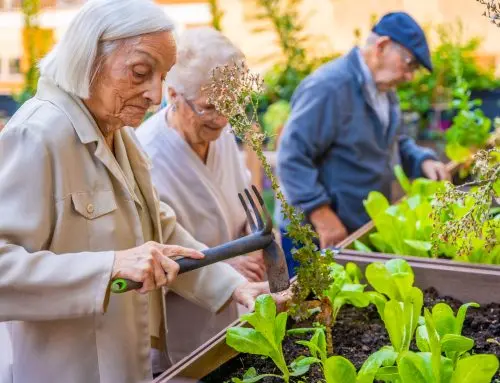
At Saguaro Ranch, a day might begin with the desert light coming through wide windows, a walk through the resident garden where your loved one tends their own fruits and herbs beneath the wide Arizona sky, followed by a yoga class, a music session, or a creative arts program. The calendar varies deliberately because the belief here is that each day should bring something worth looking forward to.
Question 5: Individual Activity Matching Is What Separates a Real Engagement Program from a Printed Calendar
Ask whether activities are assessed individually at move-in: How are activities matched to each resident’s abilities and interests? Ask what happens for residents who don’t want to participate, or who have physical limitations that make some activities harder to access. Ask whether family members can participate in activities with their loved ones.
Engagement matters. The Alzheimer’s Association’s resources on daily care and activities identify meaningful activity participation as a contributor to quality of life, mood, and behavioral wellbeing in people living with dementia.4 Even for residents not living with cognitive change, purposeful daily engagement is one of the most consistent predictors of wellbeing in a senior living setting.
Question 6: How a Community Describes Mealtime Tells You How It Values the Resident Experience
Ask whether meals are cooked on-site or catered in. Ask how dietary needs and preferences are accommodated. Ask whether residents eat together at a table or in isolation. Ask what happens if a resident doesn’t like what’s served. Meals are not just nutrition. They’re the rhythm of the day, a social anchor, and one of the most reliable indicators of how a community values the resident experience.
A community with genuine care for its residents will describe mealtime the way you’d describe a good family dinner: warmly, specifically, and with some attention to what makes it something residents actually look forward to.
Questions About Care Plans, Safety, and Family Partnership
Question 7: A Genuinely Useful Care Plan Is a Living Document, Reviewed and Updated as the Resident Changes
Ask who is involved in the initial assessment: How is a care plan developed and how often is it reviewed? Ask whether the family has a role in developing the plan. Ask what triggers an update.
Every resident in an Arizona assisted living community is entitled to an individualized service plan, a written document that outlines the specific support they’ll receive.2 What matters beyond the legal minimum is how that plan is built and maintained. A care plan that genuinely serves a resident is a living document. It should change when the resident changes. Communities that offer vague answers about this are often running one-size care models, regardless of what their marketing materials say.
Question 8: Safety and Accessibility Built into the Architecture Signal a Community That Takes Prevention Seriously
Ask about fall prevention features: grab bars, non-slip flooring, lighting at night, accessibility in bathrooms. Ask what safety and accessibility features are built into the community and about emergency response procedures. Ask how the community handles medical situations that arise at night or on weekends.
The Centers for Disease Control and Prevention’s falls prevention research identifies falls as the leading cause of injury among older adults, and environmental design as one of the most effective preventive strategies.5 In a community that takes this seriously, the design reflects it and caregivers can describe it in concrete terms, not just reassuring ones.
If your loved one needs memory care support, ask specifically about environmental features that address wandering risk and disorientation. The physical design of a memory care environment is as much a part of care as anything a caregiver does.
Question 9: How a Community Handles Evolving Care Needs Is One of the Most Important Questions to Ask
Ask what kinds of care changes the community is equipped to support in-house: How do you handle a change in a resident’s needs over time? Ask what the process looks like when care needs exceed what the community can provide. Ask how families are involved in that conversation.
A community that answers honestly, including where its limitations are, is a community you can trust. The answer you want is one that prioritizes the resident’s wellbeing over a smooth sales conversation.
The Question Most Families Forget to Ask
Question 10: Family Communication After Move-In Reveals Whether the Community Sees You as a Partner or a Visitor
Ask whether the community has a named family point of contact. Ask how the community will communicate with your family after moving in, how they handle routine updates versus urgent changes, whether the family is involved in care plan reviews, and what proactive communication looks like on a normal week when nothing is wrong.
The answer tells you something fundamental: does this community see the family as a partner in care, or as a visitor with limited hours? That distinction shapes the experience for everyone, including your loved one.
What to Observe While You’re on the Tour
Your questions open the conversation. Some of the most important information you’ll gather isn’t spoken, it’s visible. Here’s what to watch for:
- How caregivers interact with residents they pass in hallways or common spaces without being prompted
- Whether residents look engaged, calm, and at ease or isolated and quiet in ways that feel more like withdrawal than rest
- The physical environment: is it clean without being sterile? Does it feel like a home or a waiting room?
- Whether your questions are answered directly, with specifics or deflected toward general assurances
- How the community smells, sounds, and feels at the time of day you visit not just how it looks in photos
- Whether you feel genuinely welcomed, or efficiently walked through a presentation
The AARP’s guidance on evaluating senior living communities advises families to tour communities at different times of day, including during a meal, to observe how the environment functions outside of scheduled tour hours.3 A community that invites that kind of open viewing is one that has nothing to hide.
What Families Find When They Tour Saguaro Ranch
Saguaro Ranch Luxury Assisted Living sits at the foot of the Tortolita Mountains, wrapped in the open landscape of the Sonoran Desert, saguaro cacti rising against the wide Arizona sky, the kind of natural beauty that doesn’t need explanation to be felt. It’s a setting unlike anything else in Tucson senior living, and it shapes the experience of every resident and family member who walks through the door.
The community is built on a single conviction: that moving into assisted living shouldn’t mean giving up on life. It should mean gaining access to the support, the community, and the daily richness that makes life genuinely worth living. That philosophy shows up in every detail from the resident garden program, where your loved one can grow and harvest their own fruits and vegetables in the Arizona sun, to the Zumba classes, the live music, the Timeslips creative storytelling sessions, and the animal visits that give residents something to look forward to every single day.
When you tour Saguaro Ranch, you’ll meet caregivers who know their residents by name, by preference, and by story. You’ll see rooms that open to the outdoors and a landscape that makes space for both rest and discovery. You’ll find a care model built around 24-hour support delivered in a setting that creates the feeling of freedom, not confinement. And you’ll find a team that will accompany your loved one to medical appointments if you can’t be there because at Saguaro Ranch, you’re family.
To learn more about the care and services offered at Saguaro Ranch, explore our assisted living and senior care approach or visit the Saguaro Ranch About page to understand the philosophy and values that shape everything we do.
Tour Evaluation: What Strong Answers Look Like vs. What to Watch For
Use this as a quick reference guide on or after your tour.
| Question | A Strong Answer Includes… | A Response Worth Noting |
|---|---|---|
| Caregiver-to-resident ratio | A specific number, confirmed for day and overnight shifts; no hesitation | Vague phrases like “fully staffed” with no specific numbers offered |
| Caregiver training | Describes ongoing training beyond state minimums; specific to memory care if relevant | Mentions only state licensing requirements; no detail on specialty training |
| Getting to know a new resident | Describes a real process: life history, family meeting, individualized welcome before move-in | Relies on intake paperwork only; no mention of family involvement in the welcome process |
| Typical daily schedule | Describes the texture of a real day with specifics; a caregiver can answer, not just the tour director | Points to a printed activities calendar without describing how residents actually experience their days |
| Activity matching | References individual assessment at move-in; describes options for different ability levels | Describes the activities program as uniform; no mention of individual fit |
| Mealtime experience | On-site preparation, social dining, dietary accommodation process, resident preferences honored | Catered or outsourced meals described vaguely; no mention of resident preferences or social setting |
| Care plan process | Family involved in initial plan; regular review schedule described; triggers for updates explained | Generic reference to “customized care” with no described process |
| Safety features | Named environmental features: grab bars, lighting, fall prevention design, emergency protocols | General assurance that “the community is safe” without architectural or procedural specifics |
| Handling changing needs | Honest description of in-house capacity and clear process for family consultation when limits are reached | Deflects the question or pivots immediately to higher levels of care without exploring in-house options |
| Family communication | Named point of contact, proactive update structure, family role in care plan reviews described | “You can call anytime” with no proactive outreach structure described |
Note: Strong answers should be specific, not just reassuring. The communities worth choosing are the ones that can answer every question on this list without deflecting because they built their operations around these questions, not around their marketing materials.
Come See the Ranch for Yourself
If you’re exploring assisted living or memory care options in Tucson, we’d love to show you what life looks like at Saguaro Ranch where the Sonoran Desert is your backyard, adventure is a daily reality, and genuine care comes from a team that knows your family by name.
Bring your list. Bring your questions. We’ll answer every one of them. And then we’ll walk you through the garden, introduce you to the people who would care for your loved one, and let the ranch do the rest of the talking.
Connect with our team to learn more or schedule your visit to Saguaro Ranch.
Frequently Asked Questions
What are the most important questions to ask when touring an assisted living community?
The most important questions address the people and the daily reality of the community: the caregiver-to-resident ratio at all hours, how caregivers learn about individual residents, how care plans are built and updated, and how the community communicates with families after move-in. These questions reveal how a community actually operates not how it presents itself on a tour.
What should I look for beyond what’s on the tour?
The most revealing moments happen outside of scripted tour elements in the unguided minutes when no one is performing. Watch how caregivers interact with residents they pass in hallways and common spaces without being prompted. Look at whether residents appear engaged and at ease. Notice how the community smells and sounds not just how it looks. And observe whether your questions are answered with specifics or deflected with general assurances.
How does Saguaro Ranch personalize care for each resident?
Care planning at Saguaro Ranch begins before a resident arrives. The team works with families to understand the person their history, preferences, daily rhythms, and what gives them joy. That foundation shapes the individualized care plan, which is reviewed regularly and updated as needs evolve. Person-centered care at Saguaro Ranch isn’t a phrase it’s how every day is built.
What activities and engagement does Saguaro Ranch offer?
The daily calendar at Saguaro Ranch includes gardening in the resident garden program, yoga, Zumba, live music, Timeslips creative storytelling, animal visits, creative arts, outings into the Tucson community, and multi-generational programming that connects residents with people of all ages. Activities are matched to individual interests and abilities the goal is purposeful engagement, not just scheduled programming.
Does Saguaro Ranch offer memory care in addition to assisted living?
Saguaro Ranch offers both assisted living and memory care support specialized, person-centered care for residents living with dementia or Alzheimer’s disease, delivered by trained memory care specialists within the same warm, ranch-style home environment. Families exploring both care levels are welcome to discuss the right fit for their loved one with our team.
This article is intended for general informational and educational purposes only. It does not constitute medical, clinical, or legal advice. Every individual’s care needs are unique and may change over time. Families are encouraged to consult with a licensed healthcare professional or care specialist when evaluating assisted living options for a loved one.
Sources
[1] National Institute on Aging.
“Long-Term Care Facilities: Assisted Living, Nursing Homes, and Other Residential Care.”
https://www.nia.nih.gov/health/residential-facilities-assisted-living-and-nursing-homes
U.S. Department of Health and Human Services.
Accessed April 2026.
[2] Arizona Department of Health Services.
“Assisted Living Licensing.”
https://www.azdhs.gov/licensing/residential-facilities/index.php
Division of Licensing Services.
Accessed April 2026.
[3] AARP.
“What to Know When Choosing an Assisted Living Facility.”
https://www.aarp.org/caregiving/basics/assisted-living-options/
AARP Public Policy Institute.
Accessed April 2026.
[4] Alzheimer’s Association.
“Activities.”
https://www.alz.org/help-support/caregiving/daily-care/activities
Alzheimer’s Association Caregiver Resources.
Accessed April 2026.
[5] Centers for Disease Control and Prevention.
“About Older Adult Fall Prevention.”
https://www.cdc.gov/falls/index.html
U.S. Centers for Disease Control and Prevention.
Accessed April 2026.